


The Six Basic Principles Of Home Organization
Aug 22, 2022
Leave a message
Most people think that storage requires diligence, and attribute the mess at home to laziness. But in fact, the correct storage is about the method.
In life, storage should not be an ineffective work that ends on a whim every time. The storage function of the home needs to be designed in advance, learn these storage principles, and help your home organization.
1. Nearby Principle
Also called the moving line principle. Home storage is not only should be beautiful in appearance, but also easy to use. A reasonable home organization must be used to reduce unnecessary movement and conform to the user's living habits. From the customization of cabinets, the installation of electrical appliances, to the item's placement on the countertop, all need to follow the nearby principle.
First, in the decoration design stage, it is necessary to plan the location of the necessary functions and the distribution of the storage area in advance according to the space layout.
Secondly, in daily use, some movable storage furniture can be adjusted according to changes in living habits to ensure convenient use and not disrupt the overall cleanliness of the home.

2. Classification Principle
Sorting the items into categories can make the home environment more concise, and it is easy to develop a good habit of storage. Before sorting, first sort out the unnecessary items, keep only the ones you need, and then make similar subdivisions and fix the position, so that each type of item has its own place.
Put the same type of items in one place. For example, when storing in the bedroom wardrobe, separate clothes, pants, and bedding. The clothes can be hung on the hanger. Use trousers racks or shelves for trousers. Bedding can be placed in the cabinet at the top of the wardrobe. Another example is the storage in the bathroom, bottled cosmetics can be stored in a unified place, the hair dryer can be fixed on the wall, and all kinds of towels can be hung on the towel rack.

3. Vertical Principle
Vertical space is often wasted because of not knowing how to use it. Traditional storage habits use vertical space in the form of stacking and adding shelf, which are not easy to take and not flexible enough.
Try changing the stacking to vertical, and changing the fixed shelf to an adjustable movable shelf, which can greatly optimize the storage space. Vertical storage can ensure the independence of items, no need to move other items when taking them, and can be applied to different scenarios such as clothes in wardrobe, small items on the desktop, and refrigerator storage.
4. Pulling Principle
The pull-out design is suitable for deep kitchen cabinets, or corner storage design. Due to the limited space at the corner, the corner cabinet is a major difficulty in home storage. With the corner pull-out basket, the space hidden in the corner can be moved freely, making it more convenient to take.
Cabinets with larger depths can be combined with drawer cabinet, it is easier to find and take the things you want, and greatly improve the space utilization rate.

5. Unifying Principle
This mainly refers to the unification of storage tools. There are many storage tools nowadays, but there should not be too many types in household applications. The storage tools and methods need to be determined according to the user and practicality. Choose the same storage product for similar items, which is easy to distinguish and form memory.

6. Semi-open Principle
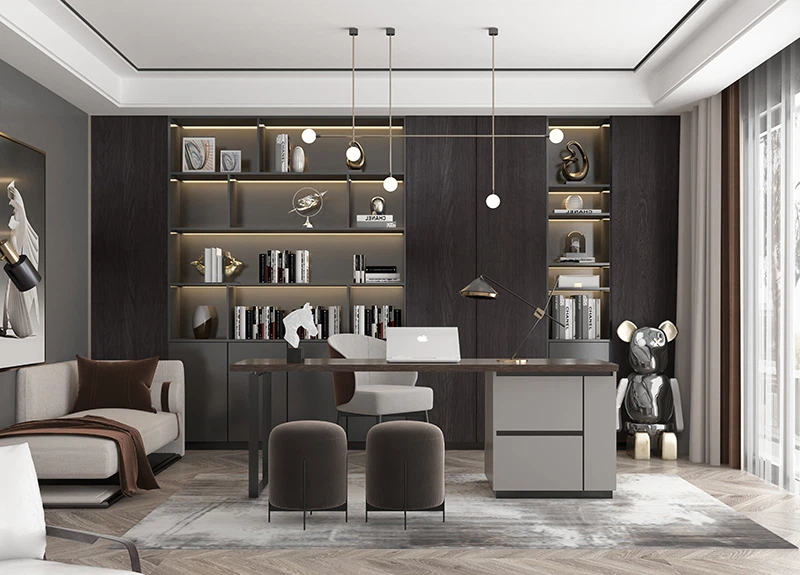
Classified by frequency of use and purpose, commonly used items are storage at open cabinet, and less commonly used items are storage at closed cabinet. The general ratio of open cabinets and closed cabinet is 2:8.
Contact our cabinetry designers, let each functional area has an appropriate semi-open design, which is not visually depressing and more convenient to use.
