


Is It Worth It To Get Custom Kitchen Cabinets
May 06, 2026
Leave a message
"Is it worth spending three times more on custom kitchen cabinets?"
Ask ten people, and nine will say: "It depends on your budget." The tenth might say: "It depends on how long you plan to live-with your kitchen, not just in your house."
This isn't another article about resale value. Because most homeowners don't build a kitchen for the next buyer. They build it for the next 5,000 breakfasts, the 10,000 times they open a drawer, and the 2,000 times they wipe down a counter.
So let's reframe the question: What kind of waste can you tolerate better-wasting money upfront, or wasting your daily experience for years?


The Financial Math (What the Appraiser Tells You)
Let's start with the numbers most articles cite.
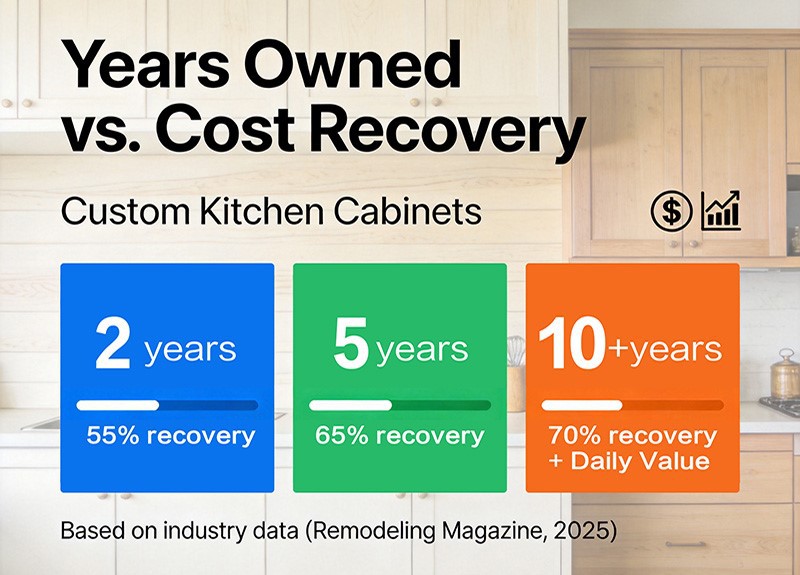
According to Remodeling Magazine's 2025 Cost vs. Value report, a minor kitchen remodel with midrange cabinets recoups about 70–80% of its cost at resale. A major upscale kitchen with custom cabinetry? Roughly 55–65%.
So yes, custom cabinets rarely pay for themselves entirely when you sell.
But here's the catch: If you plan to move in two years, custom cabinets are probably a bad investment. If you plan to stay for eight or ten years, the resale math becomes less important than another kind of math.
The Daily Math (What Your Fingers Tell You)
Let's do a different calculation.
Take a $15,000 custom cabinet set (mid‑range custom). Assume you use your kitchen daily for 10 years. That's 3,650 days. At 20 drawer or door openings per day, that's 73,000 interactions.
Cost per interaction: about 20 cents.
Now take a $5,000 stock cabinet set that feels rough, doesn't close fully, and has one drawer that always sticks. Every time you use it, you don't pay money-you pay a tiny amount of frustration.
After 73,000 interactions, the custom set has cost you 20 cents per smooth, silent movement. The cheap set has cost you nothing financially but a quiet, daily tax on your mood.
Which is the better deal?
The Hidden Cost of NOT Going Custom
Stock cabinets aren't "bad." For many budgets, they make perfect sense. But there are silent costs that never show up on a receipt:
- Wasted space – That 5‑inch gap above a stock cabinet collects dust and guilt. A custom cabinet goes to the ceiling.
- Wasted time – You search through a deep, dark corner because no pull‑out was installed. Custom gives you a corner carousel or a magic corner.
- Wasted energy – You "get used to" a drawer that doesn't align, a hinge that squeaks, or a door that won't stay open. Custom eliminates those small, daily annoyances.
These aren't luxury problems. They are quality‑of‑life leaks.


The Smart Hybrid Approach (Because It's Not All or Nothing)
At REBON, we help clients design hybrid kitchens:
| Zone | Recommendation | Why |
| High‑use zones (cooktop base, sink base, main prep area) | Custom | Frequent interaction, need for perfect height and storage |
| Corner cabinets | Custom | Unlock dead space; stock corners are notoriously inefficient |
| Upper wall cabinets | Semi‑custom or stock + filler strips | Less critical for ergonomics, can save budget |
| Pantry / tall cabinets | Custom | Maximize vertical space and shelf adjustability |
| Dish‑only cabinets / plate racks | Stock or semi‑custom | Simple storage needs, low interaction frequency |
This approach typically adds only 30–40% to the total cabinet budget but solves 80% of the daily frustrations that stock cabinets create.
Worth It Is the Wrong Question
So, is it worth getting custom kitchen cabinets?
The honest answer isn't "yes" or "no." It's "for whom and for how long?"
If you're flipping a house or moving in two years: Probably not.
If you cook daily, work from home near the kitchen, or simply value a space that works without friction: Almost certainly yes.
If you're budget‑conscious but want the biggest bang for buck: Go hybrid. Customize the pain points; save on the rest.
Most people, after a few seconds of honest thought, already know their answer.